
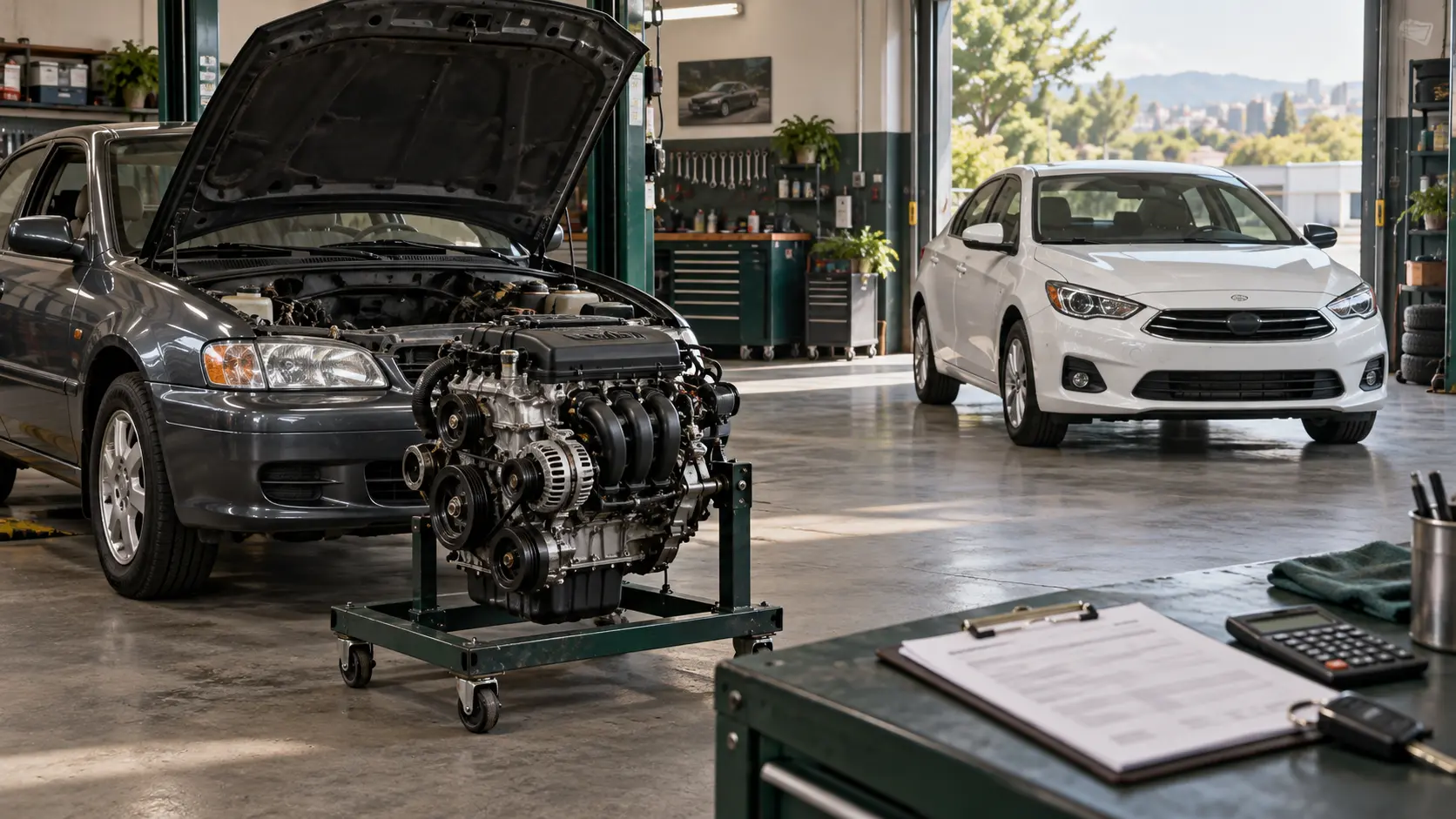
An engine quote arrives with the car already stopped
By RealCostTools. Sources checked September 19, 2026. For drivers in the United States; all amounts are U.S. dollars.
A failed engine differs from a car that is slowly wearing out in one practical respect: the car may not run while you think about it. That puts pressure on the decision which the arithmetic below cannot see, and nothing here is a reason to keep driving a car that has overheated or lost oil pressure.
The question this guide answers is narrower than the one the price pages answer. Given this quote, this car, and the replacement you would actually buy, which option costs less over the years you will drive? In the fictional example below, repairing wins at three years, the two options are identical at four, and repairing loses at five. The engine quote is the same number in all three.
Before you price anything, find out who else might pay
The cheapest possible engine is one somebody else pays for. Three free checks establish whether that is possible, and the table sets out what each reaches. Two of the details in it are worth pulling out first.
The first is procedural. The Environmental Protection Agency states that to have the manufacturer pay under a federal emission control warranty you must use a facility the manufacturer has authorized, and that a repair facility which is not authorized is not obligated to advise you of parts that are covered. The shop writing your quote may be entirely honest and still have no duty to mention coverage you already hold.
The second is that there are two recall searches, and the VIN search is not the one that helps here. A VIN search at the National Highway Traffic Safety Administration returns unrepaired safety recalls for that specific vehicle; a year, make and model search instead returns recalls, investigations, complaints and manufacturer communications. If your failure is a known pattern in your model, it is the second search that shows it, and a clean VIN result says nothing either way.
| Check | What it can reach | What it does not reach |
|---|---|---|
| Federal emission control warranties | Emission control parts that fail from a defect in materials or workmanship, for 2 years or 24,000 miles; and the catalytic converters, emissions control computer and on-board diagnostic computer for 8 years or 80,000 miles from the original sale. Used vehicles included. | The engine itself: those three are the only specified major components. Coverage can be denied where the failure came from improper use or from not following the written maintenance instructions. |
| NHTSA recall, investigation and complaint search | Unrepaired safety recalls for one VIN, or recalls, investigations, complaints and manufacturer communications for a year, make and model. Where a recall applies the manufacturer must repair, replace, refund or, in rare cases, repurchase, and the remedy is free to the owner. | Recalls already repaired, some recently announced ones, recalls over fifteen years old unless the manufacturer offers more coverage, small manufacturers, international vehicles, and manufacturer customer service or other non-safety campaigns. |
| Your own warranty or service contract | Whatever it says in writing: what is covered, the deductible, where the repairs must be performed, and whether the company pays the shop or reimburses you. | Anything assumed. The FTC states plainly that there is no standard warranty on repairs, and that warranties may be limited by time, mileage, deductibles and which businesses may do the work. |
This table restates what each source says about its own check. It is not a statement that any particular engine failure is covered, and a clean result is not evidence that a vehicle has no defect.
Reference: FTC: Auto Repair Basics · NHTSA: Check for Recalls · EPA: Frequent Questions related to Transportation, Air Pollution, and Climate Change
Rebuilt, remanufactured or salvage engine, and who warrants the labor
The FTC classifies parts as new; as remanufactured, rebuilt or reconditioned, terms it says generally mean the same thing and describe parts restored to a sound working condition; or as salvage, used parts taken from another vehicle without alteration, whose reliability it says is seldom guaranteed. Two quotes for the same failure can be built from different classes, so ask which class each quote uses.
One line matters more for an engine than for almost any other part: the FTC notes that many manufacturers warrant replacement parts but not the labor to install them. Fitting an engine is a large share of the quote, so a part-only warranty can leave you paying the expensive half twice if the replacement fails. Ask what the warranty covers before comparing prices at all.
- Whether the engine is new, remanufactured or salvage, in those words and in writing.
- Whether any part warranty covers the labor to install the part a second time.
- Whether labor is quoted at a flat published rate or at the hours actually worked; the FTC describes both conventions.
- Whether the technician has worked on your make and model before.
- A written estimate naming the condition to be repaired, the parts needed and the anticipated labor charge, signed.
- A completed repair order afterwards, listing each repair, the parts and their cost, labor charges, and the odometer reading at drop-off and at completion.
Reference: FTC: Auto Repair Basics
Why the quote is 400% of the car's value, and why that means little
One rule of thumb says never to spend more on a repair than the car is worth. Applied to an engine it almost always says no, for a circular reason: a car that will not run is worth far less than the same car running, so its value falls toward what someone will pay to tow it away. The failure you are pricing created the number you are dividing by.
In the example below, a $5,000 engine job sits against a car worth $1,250 as it stands, 400% of its value, which would rule out the repair instantly. The full comparison puts repairing ahead over three years. The collapse also works in your favor: the credit you give up by keeping the car is only that $1,250, not what it would fetch running. Neither effect is captured by a percentage.
Worked example: a $5,000 engine or a $12,000 replacement
Every input here is fictional. These are not national average engine prices, current repair-shop quotes, salvage or remanufactured engine prices, or typical figures for any particular model. Replace all of them with your own.
Assume the engine job returns the car to normal running order and you then keep it three years; that the alternative is a $12,000 used car with $1,200 in acquisition fees, paid in cash; that both cars cover 12,000 miles a year at $3.50 a gallon; and that the car as it stands, with the engine dead, would sell for $1,250. Assume no financing on either side, no further repairs beyond the $800 already expected, and no towing, rental or downtime costs. These are undiscounted costs: future payments are added at their stated dollar amounts without adjusting for the time value of money.
| Input or calculated cost | Repair this car | Buy the replacement |
|---|---|---|
| Upfront work or purchase | $5,000.00 engine | $12,000.00 car |
| Other known near-term repairs | $800.00 | $0.00 |
| Acquisition fees | $0.00 | $1,200.00 |
| Credit for selling the current car | $0.00 | −$1,250.00 |
| Fuel over three years | $6,300.00 | $4,200.00 |
| Maintenance and insurance over three years | $7,800.00 | $8,100.00 |
| Value left at the end of three years | −$1,750.00 | −$5,500.00 |
| Net three-year comparison cost | $18,150.00 | $18,750.00 |
Fuel: 12,000 miles ÷ 20 MPG × $3.50 = $2,100.00 a year for the repaired car, and 12,000 ÷ 30 × $3.50 = $1,400.00 for the replacement.
Repairing totals $18,150.00 over three years, or $6,050.00 a year. Replacing totals $18,750.00. The difference is $600.00 in favor of repairing, which is $16.67 a month.
Holding everything else constant, the two options meet at a quote of $5,600.00: below that, repairing costs less over the three years; above it, the $12,000.00 replacement does. That threshold belongs to this set of assumptions only, and it is not a repair limit for engines.
A longer engine life does not rescue the repair
A replacement engine invites a natural conclusion: a long life settles the argument, and if the engine lasts, the repair must win. In this comparison it does the opposite.
The table holds every input constant, including the quote, and changes only how long you keep the repaired car, moving the comparison period with it so both sides cover the same years. What decides it is that the repaired car costs more per year to run than the replacement would.
Most of that yearly difference is fuel, the part people are most likely to assume away. A replacement engine can restore the economy a car had when healthy, but it cannot change the car's design, weight or gearing. Do not read the ceiling off a label either: the EPA states that fuel economy ratings exist so consumers can compare vehicles, are not a guarantee of what any driver will achieve, and vary with how and where you drive and with vehicle condition and maintenance. Use the economy you have measured across a few tanks for the car you own.
| Years you keep the repaired car | Repair this car | Buy the replacement | Difference |
|---|---|---|---|
| Three years | $18,150.00 | $18,750.00 | $600.00 in favor of repairing |
| Four years | $22,850.00 | $22,850.00 | The two options cost the same |
| Five years | $27,550.00 | $26,950.00 | $600.00 in favor of replacing |
Each extra year adds $4,700.00 to the repaired car and $4,100.00 to the replacement: $1,300.00 of maintenance, $1,300.00 of insurance and $2,100.00 of fuel, against $700.00, $2,000.00 and $1,400.00. The $600.00 a year between them is what moves the answer.
At four years the two options are identical at $22,850.00 each. Before that the repair is ahead, after it the replacement is, and the engine quote never changes.
The older car is the more expensive one to run here, so every additional year spends more of the purchase price you avoided by not buying. A long engine life is worth having, but on these inputs it is not the argument for the repair that it sounds like.
Why a comparison period longer than the car's remaining life is reported as incomplete ↗
Reference: EPA: Frequent Questions related to Transportation, Air Pollution, and Climate Change
What would change this answer
The calculator's sensitivity section changes one assumption at a time and holds everything else constant. Applied to the three-year comparison, these are the results it reports.
| Change | Difference over three years |
|---|---|
| Another $2,000.00 of repairs on the repaired car | $1,400.00 in favor of replacing |
| Replacement worth $2,000.00 less after three years | $2,600.00 in favor of repairing |
| Replacement gets 5 more MPG | The two options cost the same |
| Replacement insurance $500.00 a year higher | $2,100.00 in favor of repairing |
Five more miles per gallon is worth 12,000 ÷ 35 × $3.50 = $1,200.00 a year against $1,400.00, a saving of $200.00 a year. Over three years that is $600.00, exactly the margin the repair had, so the two options land level.
These are demonstrations, not probabilities. Nothing here says a second repair is likely; it says what one would do to the comparison if it happened.
That first row deserves more weight after an engine job than after most repairs. A replacement engine resets one component. The cooling system, the transmission, the suspension and the body around it are exactly as old as they were the day before.
So is it worth replacing an engine?
On the inputs above, the same quote wins at three years and loses at five.
Which means the question that decides it is not whether the engine will last. It is how long the rest of the car will last, and what that car costs you per year while it does. An engine quote invites you to think about the engine; the arithmetic is mostly about everything else.
Two things the comparison cannot settle. Whether the car is sound apart from the engine is a question for a mechanic, and the answer sets the period you may assume. Whether you can tolerate being stranded a second time is yours alone, and it deserves weight in a decision this close.
The same comparison for a transmission quote, where the replacement you choose decides it ↗
What this guide does not tell you
It does not tell you what your engine should cost. No figure here is a market price, and we hold no labor rates or parts prices for any model. Get a written quote, then bring the number back.
It does not diagnose anything. The FTC lists difficulty starting, a lit check engine light, rough idling or stalling, poor acceleration, poor fuel economy, excessive oil use and an engine that runs on after the key is removed as reasons to get a diagnosis, not as conclusions about what has failed. On one point it is unambiguous rather than diagnostic: a sweet, steamy odor with a hot metallic scent and steam from under the hood means the engine has overheated, and it says to pull over immediately, that continued driving could cause severe engine damage, and that the vehicle should be towed.
It does not model everything. National ownership statistics combine maintenance, repair and tires into one category, so no single repair has its own national line. This comparison excludes towing, a rental while the work is done, the time spent arranging any of it, any difference in financing, and any outstanding loan on the car you own.
Reference: FTC: Auto Repair Basics · BTS: Average Cost of Owning and Operating an Automobile, Table 3-17
Run your own quote through it
Enter the engine quote as the repair, what the car would sell for as it stands as the current value, the years you honestly expect from the repaired car as both the remaining life and the comparison period, and the actual replacement you would buy. The calculator reports both totals, the difference and the monthly equivalent.
Then run it again with a different number of years and nothing else changed. If the answer moves, as it does above, your decision turns on how long the rest of the car lasts, and that is the question to take back to the mechanic.
Sources and calculation notes
- FTC: Auto Repair Basics
Used for the part classes and the point that a part warranty may not cover the labor to install it, the labor-pricing conventions, what a written estimate and a completed repair order should contain, the absence of a standard warranty on repairs, part of its service-contract checklist, the engine trouble symptoms and the overheating instruction. No price and no repair recommendation is taken from it, and its symptom list is not used as a diagnosis. The page carries an August 2012 date. Checked September 19, 2026.
- NHTSA: Check for Recalls
Used for the difference between a VIN search and a year, make and model search, for NHTSA's own list of what the VIN search does not return, and for the remedies a manufacturer must offer at no cost. No specific engine recall, investigation or complaint is cited here, and a clean search is not evidence that a vehicle has no defect. Checked September 19, 2026.
- EPA: Frequent Questions related to Transportation, Air Pollution, and Climate Change
Used for the federal emission control warranty periods of 2 years or 24,000 miles and, for three specified major components, 8 years or 80,000 miles from the original sale; for the grounds on which coverage can be denied; for the authorized-facility requirement; and separately for what EPA fuel economy ratings are and are not. The separate performance warranty, which turns on failing an emission test in an inspection and maintenance area, is not covered here, and neither are EPA's figures for the adjustments applied to label estimates or the effect of E10. The engine itself is not a covered component and this guide says so; no claim is made that any particular failure is covered. Checked September 19, 2026.
- BTS: Average Cost of Owning and Operating an Automobile, Table 3-17
Used only for how the national figures are constructed: 15,000 vehicle-miles a year, the AAA five-year new-vehicle basis, the single insurance profile, and the combined maintenance, repair and tires category since 2017. No dollar figure from the table is used in this guide; its values sit in a downloadable spreadsheet that was not opened. Checked September 19, 2026.
Read the car repair vs. replace methodology for the model assumptions and excluded costs.
Published . Sources checked . Editorial policy · Corrections