
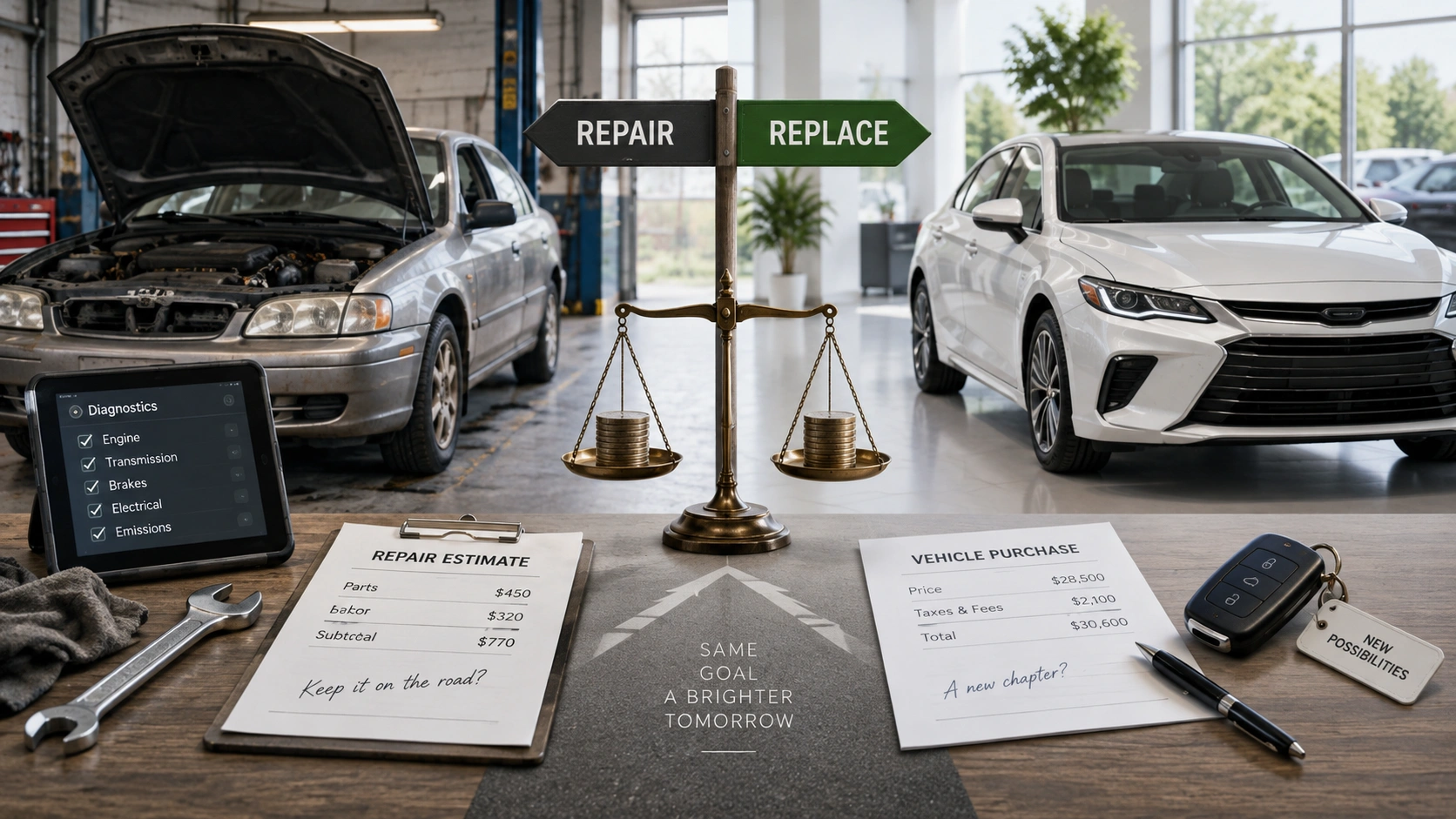
Collect assumptions for both alternatives
Get a written repair quote that identifies the work included and ask about the car's likely usable life after the repair. Use a specific replacement budget, acquisition fees and realistic running costs. An expensive new replacement is not the only alternative; a used car can have its own maintenance and financing tradeoffs.
The current car's sale proceeds belong on the replacement side. Ending vehicle values reduce the modeled net cost of each alternative. These are comparison costs, not a month-by-month bank balance.
- Repair quote and other known near-term repairs.
- Current sale value and expected ending value if kept.
- Replacement purchase price, fees and ending value.
- Annual mileage, fuel economy and gas price for both cars.
- Maintenance, insurance and relevant financing charges.
A fair comparison needs a realistic time period
If the repaired car is expected to last one year, a three-year keep-versus-replace comparison is incomplete unless it also accounts for transportation after that first year. The calculator labels this comparison incomplete and withholds a cheaper-option recommendation and sensitivity results. It does not add that later replacement automatically. Shorten the horizon or use a fuller model that includes later transportation.
The current comparison also assumes no outstanding principal balance on the existing vehicle. If you still owe principal, account for that debt consistently in a fuller model. Do not simply subtract the payoff from the sale-value input: that can make the two alternatives inconsistent.
Safety, mechanical condition, recurring disruption and dependable transportation remain separate considerations. An apparently cheaper modeled option is not a diagnosis or a guarantee that the car will last.
Ask what would change the result
For a valid comparison with every other input held constant, adding one dollar to the current repair quote adds one dollar to keeping cost. The current quote plus the displayed repair advantage therefore gives a break-even quote under those assumptions. It is not a universal repair limit.
Try a higher future repair estimate and less favorable resale values. Change one assumption at a time to see its effect, then consider whether several uncertainties could occur together. Fixed sensitivity examples are demonstrations, not assigned probabilities.
The default example below uses a three-year life and three-year horizon. Its figures are illustrative, not market averages, and should be replaced with your quotes.
Avoid confusing the payment with ownership cost
A loan payment includes principal and interest. The calculator already counts purchase price and adds interest through the modeled period, so adding every loan payment again would count principal twice. Review the loan assumptions and ending values before comparing the totals.
Use the result to identify which quote or assumption deserves another check. Edmunds also discusses nonfinancial reasons a driver may replace an older car; those considerations should remain visible alongside the arithmetic.
When it is one big repair rather than general wear
A single large quote behaves differently from a car that is simply getting old: the amount is known, it arrives at once, and it can be larger than the car would sell for. The framework above still applies, but the specifics of the quote itself matter, including whether the part is new, remanufactured or salvage, and whether anyone else might cover the work.
The transmission guide works through that case end to end, with a worked example in which the choice of replacement, not the size of the quote, decides the answer.
The engine guide works through a second case, where the car is already immobile and the quote dwarfs what the car is worth as it stands. Its worked example turns on the number of years you keep the repaired car rather than on the quote, and the answer reverses between three years and five.
Transmission replacement cost: repair the car or replace it ↗
Engine replacement cost: when another engine beats another car ↗
A worked example with inspectable inputs
| Item | Example result |
|---|---|
| Keep: modeled three-year net cost | $13,640.00 |
| Replace: modeled three-year net cost | $17,237.50 |
| Repair advantage under these assumptions | $3,597.50 |
| Break-even repair quote, all other inputs held constant | $6,597.50 |
The full inputs are the calculator's labeled opening example: $5,000 current sale value, $1,800 replacement fees, $500 other repairs, 12,000 miles/year and $3.50/gallon. Old/new MPG: 25/32; annual maintenance: $1,200/$600; annual insurance: $1,500/$1,900; ending values: $3,000/$13,000. No financing interest is included in this cash-purchase example.
These are net comparison costs after ending values, not payment schedules. The threshold is derived for this valid fixed-input case; changing future repairs, life or resale values changes it.
Illustrative figures, not market averages. The underlying costs are calculated with the same engine as the tool; additional derived measures are labeled.
Compare repair and replacement costs ↗Sources and calculation notes
- Edmunds: Should I Fix Up or Trade Up My Old Car?
Automotive decision context; article by Ronald Montoya, January 26, 2024. The numerical example here uses RealCostTools' own documented model.
Read the car repair vs. replace methodology for the model assumptions and excluded costs.
Published . Sources checked . Editorial policy · Corrections