
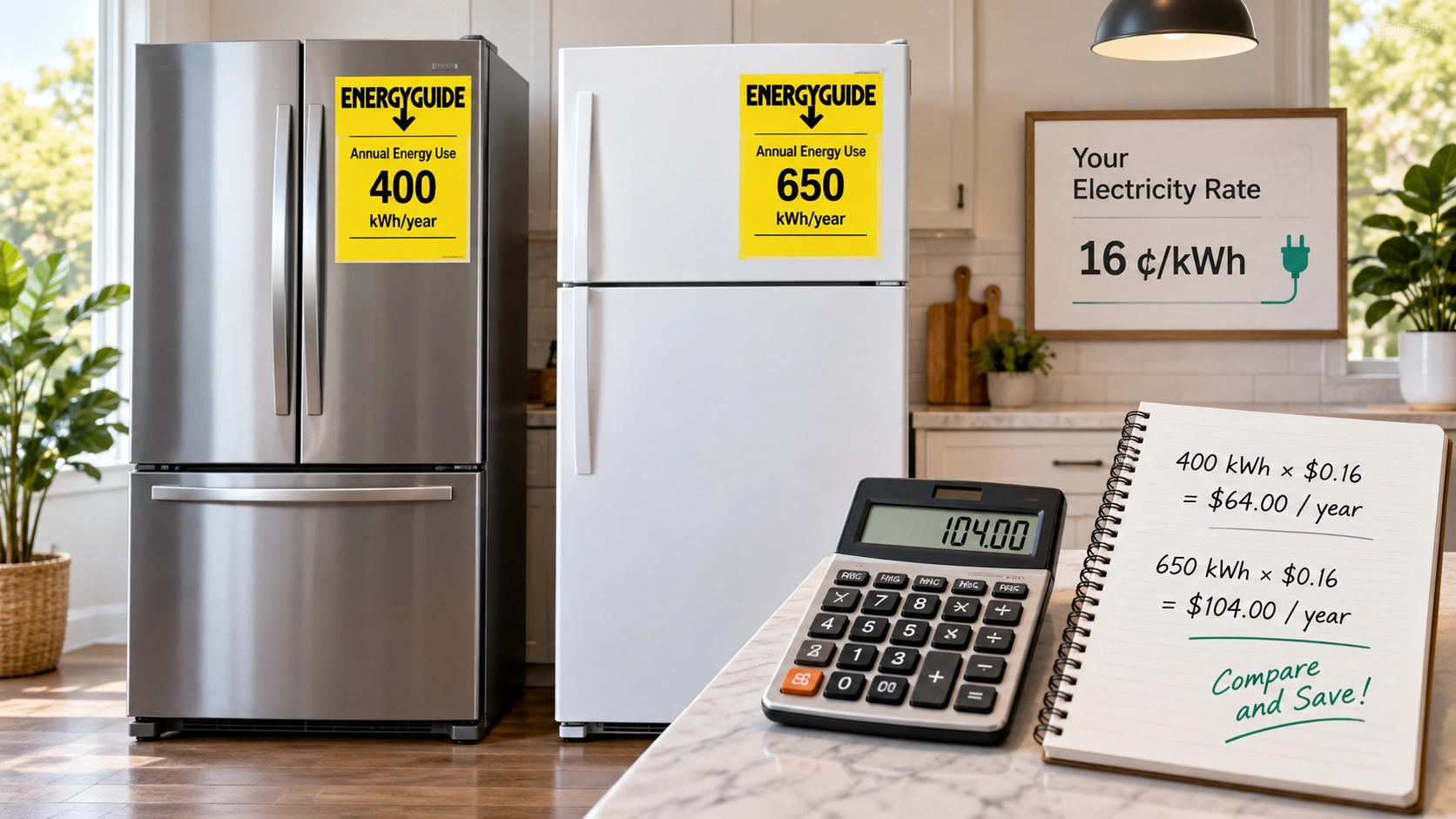
Calculate monthly and annual refrigerator electricity cost
Annual electricity charge = annual kWh × electricity price in dollars per kWh. Average monthly charge = annual electricity charge ÷ 12. Monthly average energy use = annual kWh ÷ 12.
If your bill lists cents per kWh, divide by 100 to convert to dollars: 20¢ becomes $0.20. In this calculator's cents field, enter 20, not 0.20. Multiply per-appliance energy by quantity; if your input is already a combined total, use quantity one.
| Input or result | Amount |
|---|---|
| Annual energy use | 600 kWh |
| Electricity price | $0.20/kWh |
| Annual electricity charge | $120.00 |
| Average monthly energy use | 50 kWh |
| Average monthly electricity charge | $10.00 |
These fictional inputs demonstrate the calculation. Costs use the calculator's engine. Dividing by 12 gives an average, not a forecast of identical consumption or bills every month.
Inspect the formulas and excluded costs ↗
Reference: EIA: Measuring electricity
Find annual kWh, not just the label's dollar figure
Look for annual electricity consumption in kWh/year. EnergyGuide helps compare similar appliances, but its dollar estimate uses typical use and a national energy-price assumption. Reuse the annual kWh with your own price to personalize the cost estimate.
Match the complete model number and configuration. Compare appliances that meet the same household need: a lower energy figure for a smaller appliance does not establish an equivalent replacement.
- EnergyGuide label: if it is missing, check the seller's or manufacturer's website.
- Manufacturer documentation: find annual energy consumption for the exact model.
- ENERGY STAR listings, where available: match the model, configuration and annual-kWh field.
- Recorded appliance energy use: keep the measurement period and household conditions with the reading.
Reference: FTC: How to use the EnergyGuide label · ENERGY STAR: Refrigerator model listings
What if an older refrigerator has no accessible label?
DOE describes a refrigerator and freezer rating lookup that can help identify older appliances by brand, model and other details. Coverage is limited, and a database estimate is not a measurement of your refrigerator today. Confirm the model match and record the source of any estimate you use.
Some appliances carry no EnergyGuide label at all, because the FTC rule does not cover them. Clothes dryers are the largest such household load, and the guide below works through where their published annual kWh comes from instead, and what it rests on.
Where a clothes dryer's published annual kWh comes from ↗
Reference: DOE: Refrigerator and freezer energy-rating search resource
Why refrigerator watts × 24 hours can mislead
Watts describe power at a moment; kWh describe energy used over time. For constant power, kWh = watts ÷ 1,000 × hours at that power. A nameplate power figure alone does not establish annual consumption.
The question is whether the refrigerator draws that power for those hours. Compressor operation and other loads vary, and manufacturer guidance describes different run behavior with design and operating conditions. There is no universal refrigerator duty-cycle percentage to insert into every calculation.
Model-specific annual kWh avoids inventing a runtime adjustment for a label-based estimate. It remains standardized: EnergyGuide calculations use DOE test procedures, not a measurement of your particular kitchen. This cost estimate does not determine startup-power requirements for a generator or battery.
Reference: EIA: Measuring electricity · FTC: EnergyGuide labeling FAQs for manufacturers · GE Appliances: Refrigerator run-time guidance
Distinguish label estimates from measured use
A label helps compare models under standardized conditions. Measurement describes how your appliance operated during the recorded period. Record cumulative kWh and measurement dates; do not automatically treat a short observation as a full-year average.
Room conditions, settings and usage can differ across periods. DOE field research examined refrigerator energy alongside environmental and household conditions. Its historical sample is not a current refrigerator population average.
For a second refrigerator in a garage, use its own energy input and check the model's installation requirements. Temperature suitability is model-specific; do not apply a universal garage-cost penalty or assume a kitchen estimate transfers unchanged.
Reference: DOE: Real-world energy consumption and test procedures · GE Appliances: Refrigerator location requirements
Choose a rate that matches the question
Use the per-kWh charges that apply to the electricity you are estimating. Your bill or utility plan is more relevant to your household than a state average. The calculator accepts cents per kWh and offers dated state benchmarks as reference estimates.
A fixed customer charge does not disappear when a refrigerator uses less electricity. Dividing the entire bill by kWh can therefore differ from the rate relevant to appliance savings. Keep fixed charges separate when comparing incremental operating costs.
Time-of-use and tiered tariffs need additional care. A single entered rate cannot reproduce every tariff rule or the timing of refrigerator consumption.
Compare an existing refrigerator with a replacement
Keep the rate and quantity the same so the difference reflects the energy inputs. The calculator compares an alternative annual-kWh figure with the first appliance entered, using that row's quantity. Name the first row clearly; the comparison is not against the total of all appliance rows.
Illustrative comparison: the 600-kWh refrigerator above costs $120 per year at 20¢/kWh. A fictional 400-kWh alternative costs $80 per year. The modeled difference is $40 per year, about $3.33 per month on average. These are electricity charges, not proof that buying the alternative is worthwhile.
| Annual energy input | Annual electricity charge |
|---|---|
| Existing: 600 kWh | $120.00 |
| Alternative: 400 kWh | $80.00 |
| Annual difference | $40.00 |
Age alone does not establish either appliance's consumption. Use supported inputs for both alternatives.
Quantity in the calculator: a two-appliance example
This separate fictional example compares two appliances using 500 kWh each per year with two alternatives using 300 kWh each, at 20¢/kWh. It shows how quantity multiplies the energy input on both sides of a comparison. Purchase prices are not inputs to this calculator.
| Item | Example result |
|---|---|
| Current annual energy: 500 × 2 | 1000 kWh |
| Current annual operating cost | $200.00 |
| Alternative annual operating cost: 300 × 2 × $0.20 | $120.00 |
| Annual operating savings for both appliances | $80.00 |
| Monthly average of that saving | $6.67 |
Quantity multiplies the energy input on both sides: two units at 500 kWh are compared with two at 300 kWh, at one rate. These are electricity charges only. Purchase prices, installation, disposal and payback are not modeled here; the repair-or-replace guide works those through on a five-year footing.
Illustrative figures, not market averages. The underlying costs are calculated with the same engine as the tool; additional derived measures are labeled.
Calculate appliance operating costs ↗Where this guide stops: electricity, not the replacement decision
Every figure above is an electricity charge. An annual saving is not by itself a reason to replace a working appliance, and it cannot be compared with a purchase price until you add the costs this calculator does not hold: the purchase itself, installation, disposal, financing, repairs, remaining life and future rate changes.
Payback and the repair-or-replace comparison are worked through in a separate guide, with a fictional refrigerator example that puts a repair quote and a replacement price on the same five-year footing. Bring the annual kWh figures from this page into that comparison.
Check the inputs before using the result
The result is only as useful as the energy input and price behind it. Select EnergyGuide / annual kWh, enter your figures, and read the monthly result as an average.
Calculate with my annual kWh and electricity rate ↗
Review the site's source registry ↗
- Is annual kWh for the correct model and quantity?
- Is it a standardized estimate or measured consumption over a stated period?
- Does the rate fit your tariff and question?
- Are you comparing electricity alone or a complete purchase decision?
Sources and calculation notes
- FTC: How to use the EnergyGuide label
August 2022 guidance, checked September 16, 2026. Label assumptions, comparable appliances and finding missing labels.
- EIA: Measuring electricity
Undated reference, checked September 16, 2026. Power and energy units; this guide's numerical examples are illustrative.
- FTC: EnergyGuide labeling FAQs for manufacturers
May 2013 page, checked September 16, 2026. DOE test-procedure basis; not a claim that old reference prices are current.
- ENERGY STAR: Refrigerator model listings
Inspected listings identify Most Efficient 2025; checked September 16, 2026. Model, configuration, capacity and annual-kWh fields, not a 2026 market average.
- DOE: Refrigerator and freezer energy-rating search resource
November 10, 2023 resource description, checked September 16, 2026. Limited model coverage; no individual model lookup result is asserted here.
- GE Appliances: Refrigerator run-time guidance
Undated manufacturer guidance, checked September 16, 2026. Operating variation; not a universal duty-cycle rule.
- DOE: Real-world energy consumption and test procedures
September 26, 2011 field study; sections 11–12, printed pages 25–37. Checked September 16, 2026. Historical measurement context, not current population averages or a universal seasonal adjustment.
- GE Appliances: Refrigerator location requirements
Undated manufacturer guidance, checked September 16, 2026. Model-specific installation conditions; no generalized garage-cost multiplier.
Read the appliance electricity cost methodology for the model assumptions and excluded costs.
Published . Sources checked . Editorial policy · Corrections