
What the higher 2026 limit actually changes
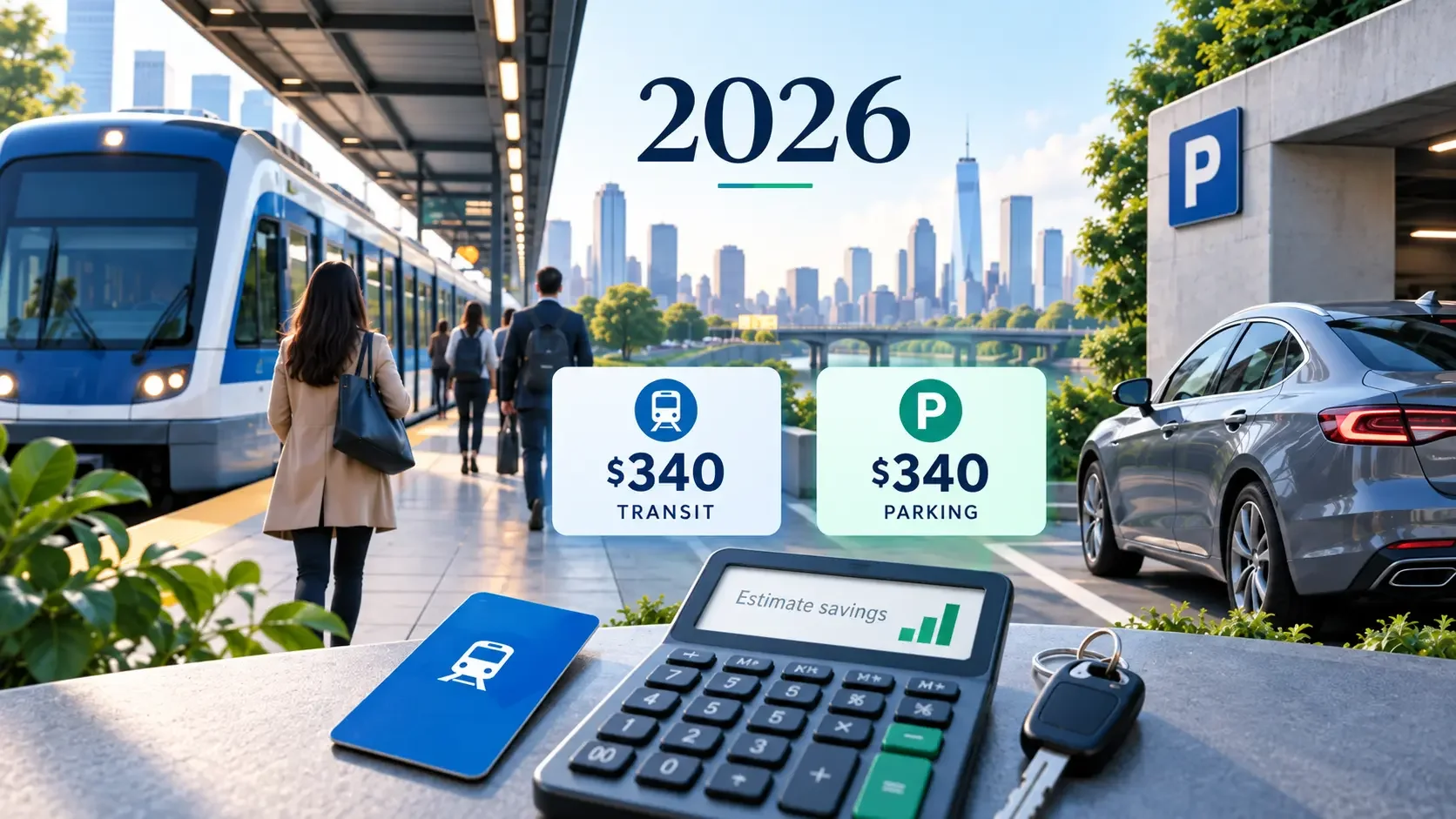
The monthly limit increased from $325 in 2025 to $340 in 2026. That provides up to $15 more exclusion capacity per month in each category. It does not provide $15 of guaranteed tax savings.
Transit and qualifying commuter-vehicle transportation share one limit. Qualified parking has a separate limit.
| Question | What the limit means |
|---|---|
| Does the higher ceiling change a $200 monthly qualifying purchase? | It fits below both ceilings. The ceiling increase itself creates no additional exclusion for that purchase. |
| How much additional exclusion capacity is available? | Up to $15 per month per category, subject to qualifying benefits and plan arrangements. |
| What does that represent over twelve months? | Up to $180 of additional excluded amount per category, not $180 of tax savings. |
Reference: IRS: 2026 commuter-benefit limits · IRS: the increase from the 2025 to 2026 limits
Separate employer money from your own contribution
An employer contribution supplies employer money toward the benefit. An employee salary reduction exchanges your wages for qualifying transportation benefits. Your employee tax saving is the tax avoided because those wages were properly excluded.
An employer contribution that replaces a purchase you would otherwise make relieves that expense. Moving your own wages into a commuter account does not create an equally large employer subsidy.
Employer and employee funding share the applicable exclusion limit within the category. Before selecting an election, record the following amounts.
| Item | Where to obtain it |
|---|---|
| Qualifying purchase price for the month | Your fare, parking price or purchase record |
| Employer contribution toward that purchase | Employer benefit documents |
| Amount you must fund | Purchase price and confirmed employer funding |
| Existing usable account balance | Benefit account |
| Remaining exclusion capacity | Payroll or benefit administrator |
| Permitted new election and deadline | Employer plan |
An existing balance may reduce the new contribution you need. Check how your plan applies that balance.
Reference: IRS: Employer’s Tax Guide to Fringe Benefits · Federal law: qualified transportation benefits
What expenses and employees qualify
Qualification depends on the federal definitions and the arrangement providing the benefit.
- Transit: qualifying passes, tokens, farecards, vouchers and similar fare items.
- Commuter vehicles: vehicles meeting the applicable seating and use requirements; sharing a ride alone does not establish qualification.
- Parking: certain workplace and connecting-trip parking; residential parking is excluded.
- Fuel and tolls: ordinary solo-driving fuel and tolls are outside these qualified transportation categories.
- Rideshares: a provider’s name does not establish eligibility. The transportation must meet the relevant definition.
- Self-employed individuals and certain owners, including more-than-2% S-corporation shareholders, face eligibility restrictions.
- The federal exclusion for qualified bicycle-commuting reimbursements was permanently eliminated for tax years beginning after 2025.
Reference: IRS: Employer’s Tax Guide to Fringe Benefits · Federal law: qualified transportation benefits
How to estimate the tax saving
First establish the employee wages that will actually be excluded. Then identify the taxes that would otherwise apply to those wages.
For a simple case in which the same rates apply throughout the excluded amount:
Estimated employee tax saving = excluded employee wages × applicable employee tax rates.
This shortcut requires unchanged relevant deductions and credits and no crossed tax threshold. Otherwise, compare the relevant tax calculations before and after the exclusion.
A marginal income-tax rate applies to the affected layer of taxable income. It is not necessarily the rate applying to every dollar you earn. Do not count the employer’s payroll-tax share as your personal saving.
| Tax component | What needs checking |
|---|---|
| Federal income tax | The affected taxable-income layers and relevant deductions or credits |
| Social Security | Whether the excluded wages would otherwise be taxed below the annual maximum |
| Regular Medicare | Whether those wages would otherwise incur employee Medicare tax |
| Additional Medicare Tax | Whether the exclusion affects that liability |
| State and local taxes | Whether the benefit receives the relevant exclusion in your jurisdiction |
Reference: IRS: Employer’s Tax Guide to Fringe Benefits · IRS: how marginal income-tax brackets work · IRS: 2026 employee payroll taxes · Social Security Administration: annual taxable maximum · IRS: withholding and estimated tax for 2026
Worked example: a $200 monthly transit purchase
This fictional U.S. commuter buys a qualifying $200 monthly pass throughout the year and receives no employer transit subsidy. The fare is an authored example, not a quote from a transit agency.
Open the commute calculator and expand “Compare transit or a job offer.” Enter $200 in “Monthly public transit fare,” then select “Calculate my estimate.” Read “Transit fare / year.” Leave the other opening inputs unchanged for this fare-only check.
| Item | Example result |
|---|---|
| Monthly transit fare (fictional input) | $200.00 |
| Annualization built into the current engine | 12 monthly fares |
| Annual transit fare: $200 × 12 | $2,400.00 |
| Tax saving | Not calculated |
The office-day setting does not change this annual fare calculation. The tool assumes the monthly fare continues throughout the year.
The $2,400 is the price of the passes. It establishes neither personal tax savings nor employer acceptance. The next section separately illustrates conditional payroll-tax components.
Illustrative figures, not market averages. The underlying costs are calculated with the same engine as the tool; additional derived measures are labeled.
Check my commute and transit costs ↗Reference: RealCostTools: commute methodology
Separately calculated payroll-tax illustration
The following amounts are derived in this guide. They are not tax results produced by the commute calculator. Each amount applies only when the stated condition holds for the properly excluded employee wages.
| Component | Required condition | Amount |
|---|---|---|
| Social Security | The entire $200 would otherwise incur employee Social Security tax, considering the annual maximum. | $200 × 6.2% = $12.40 |
| Regular Medicare | The entire $200 would otherwise incur regular employee Medicare tax. | $200 × 1.45% = $2.90 |
| Combined regular payroll taxes | Both conditions above apply. | $12.40 + $2.90 = $15.30 |
If the full $2,400 annual exclusion meets both conditions, the corresponding regular employee payroll-tax saving is $2,400 × 7.65% = $183.60.
These amounts exclude federal income-tax effects, state/local taxes and Additional Medicare Tax. They are not the commuter’s complete personal tax saving.
If annual Social Security wages remain above the 2026 $184,500 maximum both before and after the election, the annual Social Security saving is zero. Regular Medicare remains a separate component where applicable.
Reference: IRS: 2026 employee payroll taxes · Social Security Administration: annual taxable maximum
Keep the calculator result separate from tax and employer adjustments
Use the commute calculator to establish modeled transportation spending. Complete the benefit comparison separately using confirmed employer funding and applicable tax effects.
| Calculator behavior | How to interpret it |
|---|---|
| Transit fare is multiplied by 12 | Record your actual purchase schedule separately if you buy passes during fewer months. |
| Transit excludes employer reimbursement | Account for employer transit funding separately. |
| Driving reimbursement reduces modeled driving expenses | Do not enter employee salary reduction in this field. Reimbursement is capped at modeled driving expenses. |
| The job-offer input uses increased take-home pay | Do not add a tax benefit again if it is already included in that take-home figure. |
| Time value is separate from cash spending | Keep it separate from tax savings. |
Check my commute and transit costs ↗
Compare a salary increase with additional commuting costs ↗
Reference: RealCostTools: commute methodology
Carryover does not remove the monthly limit
Unused salary reductions may carry forward under your employer’s plan. A carried balance does not turn the monthly exclusion into an unrestricted annual allowance.
The federal regulation includes an example of funds carrying into the next year while the applicable monthly limit continues to apply. It also restricts election timing and prohibits a plan from providing cash refunds of excess salary reductions merely because participation ends.
Before changing contributions or leaving a job, establish how existing funds can be used, the deadline for changing the next election, which expenses and benefit periods remain eligible, and what happens to unused funds when participation ends.
Avoid funding an account simply because there is room under the cap.
Reference: Federal regulation: elections, carryover and refunds
Check fees, unused funds and the final tax result
A tax exclusion does not, by itself, establish the arrangement’s complete value to you. Check employee-paid charges and whether you will use the elected funds for qualifying purchases. For a comparison involving fees or unused funds, show those amounts separately rather than presenting the tax saving as the final budget gain.
For a purchase funded entirely by your own election, with all elected funds used and no fees: effective purchase cost = purchase price − taxes avoided. Account for employer funding separately when it applies, and keep every amount in the same period.
Income-tax withholding is a payment during the year. Your return reconciles those payments with your actual liability, including relevant deductions and credits. A payroll preview therefore does not establish the final annual income-tax benefit.
Choose your election from the qualifying purchases you expect to make, the employer funding available and the balance you already hold. Confirm the plan’s deadline and payroll treatment. After the election takes effect, compare the deduction and resulting pay statement with the information you received.
Reference: IRS: Employer’s Tax Guide to Fringe Benefits · IRS: withholding and estimated tax for 2026
Sources and calculation notes
- IRS: 2026 commuter-benefit limits
Revenue Procedure 2025-32, section 4.16, PDF page 19. Released October 9, 2025; U.S. federal limits for tax years beginning in 2026: $340 per month for combined transit and commuter-highway-vehicle transportation, separately $340 for qualified parking.
- IRS: Employer’s Tax Guide to Fringe Benefits
Publication 15-B, 2026 edition, posted December 23, 2025. Table 2-1 and Qualified Transportation Benefits explain U.S. federal exclusions and compensation reduction agreements. Eligibility and plan requirements still apply.
- Federal law: qualified transportation benefits
26 U.S.C. section 132(f)(1), (2), (4), (5) and (6), reproduced by Cornell LII. Current statutory text checked September 12, 2026; amendment history includes July 4, 2025. Definitions and combined-benefit rules only; use the IRS 2026 release for indexed dollar limits.
- IRS: how marginal income-tax brackets work
Undated explanatory text, checked September 12, 2026. Used only for the U.S. federal marginal-tax concept. The older numeric tables on this page are not used as 2026 thresholds.
- IRS: 2026 employee payroll taxes
Publication 15, 2026 edition, posted December 17, 2025; section 7. U.S. employee Social Security: 6.2%, taxable-wage limit $184,500. Regular employee Medicare: 1.45%, no wage-base limit. The section also explains Additional Medicare Tax withholding.
- Social Security Administration: annual taxable maximum
Undated current reference checked September 12, 2026; explicit 2026 U.S. data. The annual Social Security taxable maximum is $184,500. Supports the limitation when wages remain above the maximum with and without an election.
- Federal regulation: elections, carryover and refunds
26 CFR section 1.132-9, Q&A 9, 14(b)–(d) and 15, reproduced by Cornell LII. Regulation dated January 11, 2001; amendment history through October 20, 2006. Current text checked September 12, 2026. Historical dollar examples are not used as current limits.
- IRS: withholding and estimated tax for 2026
Publication 505, 2026 edition, posted April 3, 2026. Introduction, Expected Taxable Income and Expected Taxes and Credits explain payment reconciliation and U.S. federal tax estimation.
- RealCostTools: commute methodology
Methodology reviewed September 5, 2026; model rechecked September 12, 2026. Transit uses 12 monthly fares and assumes no employer transit reimbursement. Tax consequences are excluded. The fictional fare example uses the same calculation engine as the tool.
- IRS: the increase from the 2025 to 2026 limits
IR-2025-103, October 9, 2025. U.S. federal monthly commuter-benefit and parking limits increase to $340 for 2026, up $15 from 2025. The $180 twelve-month difference is derived exclusion capacity, not tax savings. Checked September 12, 2026.
Read the commute & hybrid work costs methodology for the model assumptions and excluded costs.
Published . Sources checked . Editorial policy · Corrections